AI strategy
Agentic AI and how it differs from process automation
Artificial Intelligence · 11 July 2026 · 7 min read
Agentic AI has become the buzzword of the year, yet behind the label sits a genuine technical shift. This article explains what sets an autonomous AI agent apart from classic, deterministic process automation, when each approach is the right choice, and how the two combine into a reliable system.
What agentic AI really means
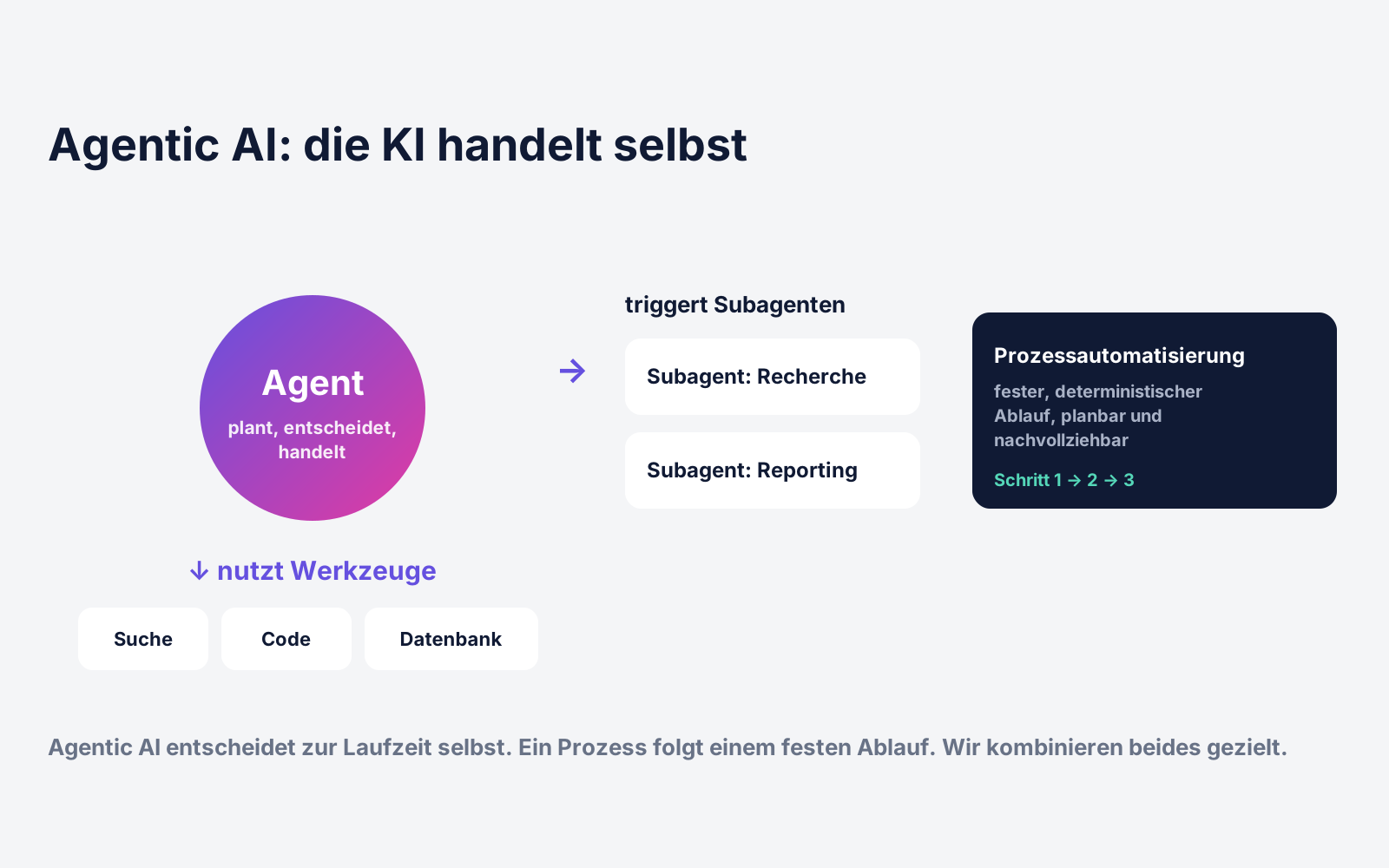
Agentic AI describes an AI system that does not merely describe a goal but works toward it on its own. Technically, such an agent is usually built on a large language model (LLM) that acts as the planning and decision-making layer. The agent breaks a task into steps, chooses the right tools at runtime and carries out actions, rather than following a predefined script.
Three capabilities are decisive here. First, the agent uses tools: search, code execution, APIs and databases. Second, it keeps context across multiple steps, so earlier results feed into later decisions. Third, when needed it can spawn or trigger further agents, so-called subagents, that take on clearly scoped subtasks and report their result back.
From this interplay emerges behaviour that is dynamic and adaptive. The path to the goal is discovered during execution, not fixed in advance. That is exactly what makes agentic AI powerful when the task is open-ended, and demanding when traceability and repeatability are what matter most.
Process automation: the deterministic approach
Classic process automation works in a fundamentally different way. Here a flow is modelled once and then executed exactly as specified: a fixed sequence of steps, orchestrated by a workflow engine. What happens when a step fails, which condition leads to which branch and in what order everything runs, is all defined up front.
This deterministic character is not a drawback but the actual value. A fixed flow is predictable, it can be tested, versioned and logged end to end. Given the same input, it produces the same output. For processes where reliability and auditability count, that is the basis for trust and for meeting regulatory requirements.
The decisive difference: determinism
The core of the difference can be compressed into a single word: determinism. Process automation is deterministic, agentic AI is not. An agent chooses its own path at runtime, which makes it flexible but harder to predict. Along several dimensions the contrast becomes concrete:
- Determinism: the process follows a fixed script, the agent decides situationally and may take different paths given the same input.
- Predictability: the process yields reproducible results, the agent yields plausible but not guaranteed identical outputs.
- Control and auditability: the process is traceable step by step, the agent needs added observability to make its reasoning transparent.
- Flexibility: the process excels at clearly bounded tasks, the agent excels at open, unstructured questions.
- Failure mode: the process breaks visibly at defined points, the agent can drift subtly from the goal or call unexpected tools.
- Best-fit use cases: the process suits routine and compliance, the agent suits research tasks, assistance and dynamic tool use.
The important insight is that neither approach is inherently superior. They solve different classes of problems. The real competence lies in making the right choice for a concrete task and in drawing the boundary between the two deliberately.
Where agentic AI shows its strengths
A vivid example is an internal assistant or chatbot that has access to real tools. An employee asks a question that cannot be answered with a single database query, for instance: what open items exist for customer X and what should we do next?
A rigid process would have to anticipate every conceivable question in advance. An agent, by contrast, decides for itself which tools to combine. It searches the knowledge base, queries the CRM, checks the ticket status and drafts a reply or a document from all of it. If its context is not enough, it hands a subtask to a specialised subagent that is responsible, say, only for contract review.
This open-ended, tool-using behaviour is exactly what a hard-wired flow cannot represent well. As soon as the range of possible requests is large and the required combination of sources is unpredictable, agentic AI plays its advantage: it improvises a sensible path to a solution instead of failing on a situation nobody planned for.
When a deterministic process is the better choice
Conversely, there are flows where autonomy is a risk rather than an asset. Repeatable, high-volume, compliance-relevant or mission-critical processes require every step to remain predictable. Invoicing, data pipelines and approval flows are typical examples: what counts here is that a thousand runs proceed identically and can be audited at any time.
For this reliable foundation, ORO Solutions relies on a workflow engine, specifically Temporal. It executes long-running processes robustly, retries failed steps in a controlled way and makes every state traceable. The result is a deterministic backbone a company can depend on, even when individual systems are temporarily unavailable.
The pragmatic path: combine both
The most compelling architecture does not come from an either-or, but from a deliberate combination. A deterministic workflow forms the reliable backbone, and where open-ended reasoning and flexible tool use create real value, an agent is embedded on purpose. That keeps the overall solution controllable without giving up the strengths of autonomous AI.
For an agent to work safely inside such a system, it needs guardrails. Three have proven themselves in practice:
- Human-in-the-loop: a person confirms critical actions before they are carried out.
- Limited tool scope: the agent is granted access only to the tools and data its task genuinely requires.
- Observability: every step, every tool call and every decision is logged and can be reviewed after the fact.
In this way the reliability of the deterministic process combines with the adaptability of agentic AI. It is precisely at this interface that solutions emerge which hold up in daily use rather than only impressing in a demo.
Would you like to know which parts of your processes suit a deterministic workflow and where an AI agent adds real value? Talk to our CTO. We analyse your use case and design an architecture that allows autonomy where it helps and secures control where it counts.
FAQ
Frequently asked questions
Is agentic AI just a better chatbot?
No. A classic chatbot answers questions from a model or a fixed knowledge base. An agent plans, decides and acts: it calls tools, queries systems, produces drafts and can hand subtasks to subagents. The chatbot is one possible interface, the agentic behaviour behind it is the real difference.
Does agentic AI replace classic process automation?
No, the two complement each other. Deterministic processes remain the right choice for repeatable, auditable and mission-critical flows. Agentic AI is strong on open, unstructured tasks. In practice you combine a deterministic backbone with agents embedded on purpose.
How do you keep control over an autonomous agent?
Through guardrails. Critical actions are confirmed by a person (human-in-the-loop), the agent receives only limited tool and data access, and every step is logged so its reasoning stays traceable.
Why does ORO use a workflow engine like Temporal?
Temporal executes long-running processes robustly and deterministically. Failed steps are retried in a controlled way and every state is traceable. That yields a reliable backbone on which agentic capabilities can be layered safely.
Keep reading
Related articles