Open source in focus
Hermes Agent: multi-stage AI work without window chaos
AI Tooling · 11 July 2026 · 9 min read
Multi-stage AI tasks rarely fail because of the model. They fail because of orchestration: too many open windows, copied intermediate results, lost context. Hermes Agent, the open-source project from Nous Research, bundles these steps into a single, continuously running agent. We cover what the tool does, where its limits are, and how ORO Solutions sets it up for you.
What Hermes Agent is
Hermes Agent is an open-source, autonomous AI agent that the research team at Nous Research released in early 2026 under the MIT license. The source code is public on GitHub, and installation runs through a single command in the terminal. Unlike a pure chat assistant, Hermes is built to work through tasks on its own across several steps, using tools, terminals and external services along the way.
The core of the project is a simple but consequential idea: an agent needs more than a language model. It needs persistent state, schedulable tasks and real connections to the outside world, and it needs them from the first minute. Hermes ships those building blocks in the box rather than leaving each team to build them from scratch.
The problem: window chaos
Anyone doing multi-stage AI work today knows the pattern: one tab for research, a second for the summary, a third for the draft, plus several editor panes where prompts and outputs are copied back and forth by hand. Every step lives in its own window, and the person is the only glue in between.
This approach is error-prone and hard to repeat. Context is lost the moment a window is closed. Intermediate results exist only as selected text on the clipboard. And as soon as the same chain has to run again the next day, the manual work starts over.
Why Hermes fits multi-stage work
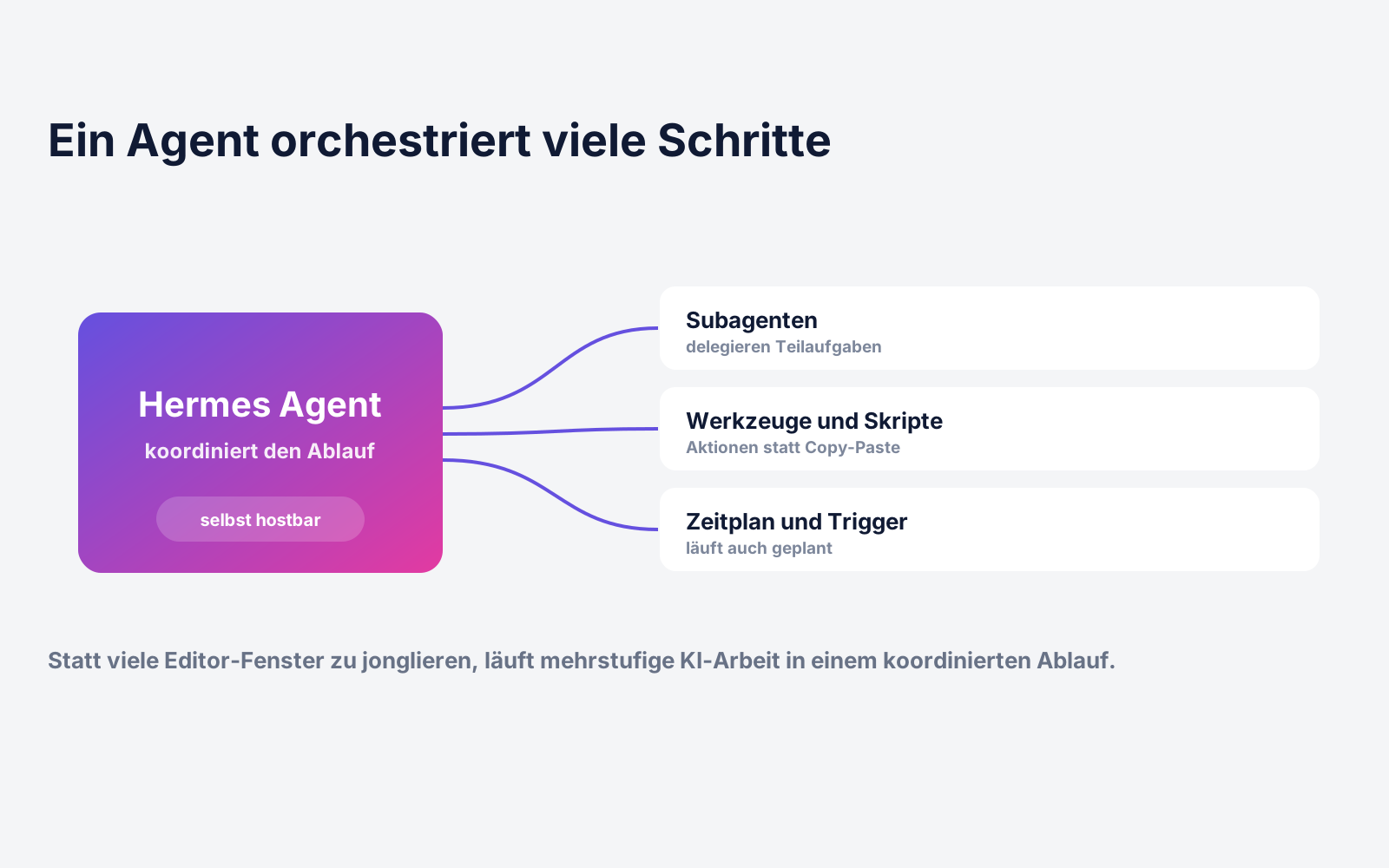
Hermes replaces this manual juggling with a single, continuously running process. Instead of spreading steps across windows, you describe the goal, and the agent chains the required steps together itself: research, execute, check, hand off. For parallel subtasks, Hermes can spawn its own subagents, each with its own conversation and its own terminal.
- Step chaining: one goal, several tool calls, one continuous context instead of copied intermediate states.
- Subagents: parallel subtasks in isolated conversations, merged back into the main run.
- More than 40 built-in tools, including web search, browser automation, image analysis and image generation.
- Scheduled runs through a built-in cron scheduler, for example for recurring reports.
- Model agnostic: usable with Nous Portal, OpenRouter, OpenAI or your own endpoints.
The practical gain is repeatability. A chain that works once can be scheduled and triggered again, without anyone opening windows and copying text.
The learning loop: skills that stay
The feature that sets Hermes apart from many other agents is its built-in learning loop. When the agent solves a non-trivial task successfully, it extracts the underlying approach as a named skill, a kind of template along the lines of: when the context looks like this, this approach works.
These skills are stored as readable Markdown files on your own machine, with no proprietary format and no cloud requirement. Over time, Hermes refines them during use, searches past conversations with full-text search and builds a growing model of user preferences.
For multi-stage work this is decisive: the second run of a chain benefits from the first. Knowledge is retained instead of disappearing with every closed window.
Self-hosting: data under your control
Hermes is designed for self-hosting from the ground up. The agent runs where you put it, and the skills and conversations it produces stay under your control.
- Runs on a cheap VPS, on GPU clusters or serverless via Modal and Daytona.
- Execution backends: local, Docker, SSH, Singularity, Modal and Daytona, with container hardening and namespace isolation.
- Platforms: Linux, macOS, WSL2, native Windows via PowerShell, Docker and Termux on Android.
- Connections to messengers such as Telegram, Discord, Slack, WhatsApp and Signal through a single gateway process.
For companies with data-protection requirements, the self-hosting approach is the real lever: sensitive content never leaves your own infrastructure, and the serverless options keep costs low during idle periods.
Honest limitations
As promising as the project is, a few points belong in an honest assessment. Hermes is young. The first release is only a few months old, and a tool at this stage evolves quickly, which also means that details can change between versions.
It is, moreover, an autonomous agent for the command line and connected messengers, not a graphical builder with drag-and-drop pipelines. Anyone expecting a purely visual interface has to be ready to work in a terminal.
- Setup effort: models, keys, backends and permissions all need clean configuration.
- Running costs: model calls through external providers create ongoing costs that need to be managed.
- Edge cases: on Android a curated installation path is required, and Windows virus scanners can flag bundled tools by mistake.
None of these points is a deal-breaker. They simply show that a productive deployment takes planning, from model choice through permissions to monitoring.
ORO Solutions: setup and integration
This is exactly where ORO Solutions comes in. We assess whether Hermes Agent fits your use case, set the agent up in your infrastructure and connect it cleanly to existing systems, models and security requirements.
From the first multi-stage chain through scheduled runs to monitored continuous operation, we guide the rollout so that an open-source tool becomes a reliable building block of your process automation. Get in touch if you want to lift your multi-stage AI work out of the window chaos.
FAQ
Frequently asked questions
Is Hermes Agent really open source and free?
Yes. Hermes Agent is released under the MIT license and is publicly available on GitHub. Costs arise only for the models you use and the infrastructure you run the agent on.
Can I self-host Hermes Agent?
Yes. The project is designed for self-hosting and runs locally, in Docker, over SSH or serverless. That keeps your skills and conversations under your control.
Why is Hermes better for multi-stage work than several chat windows?
Instead of copying prompts and outputs between windows by hand, Hermes chains the steps in one process, keeps the context and can schedule and repeat runs.
Does using it require programming knowledge?
Not strictly for daily use via terminal or messenger. For setup, model connection and secure operation, technical knowledge is helpful, and that is precisely where ORO Solutions supports you.