Speech Technology
Translating Standard German to Swiss German
Speech Technology · 11 July 2026 · 9 min read
Swiss German is a spoken language with no binding orthography. We explain why converting Standard German into dialect is technically demanding, where modern language models already excel, which systematic error keeps recurring, and which methods make the output controllable.
Why converting into Swiss German is genuinely hard
Swiss German is first and foremost a spoken language. There is no binding, officially defined orthography a system could anchor itself to. The same sentence can be written down correctly in many ways, and none of these spellings is objectively wrong. This sets the task fundamentally apart from a classic translation between two standardized written languages, where a target result is far easier to define.
On top of that comes strong regional variation. Zurich, Bern and Basel differ in both pronunciation and vocabulary. A system that produces dialect therefore has to implicitly pick a region, because a neutral Swiss German that sounds the same everywhere does not exist. Anyone who speaks of simply translating into Swiss German underestimates how many choices between dialects, spelling conventions and registers are involved.
What modern language models can do today
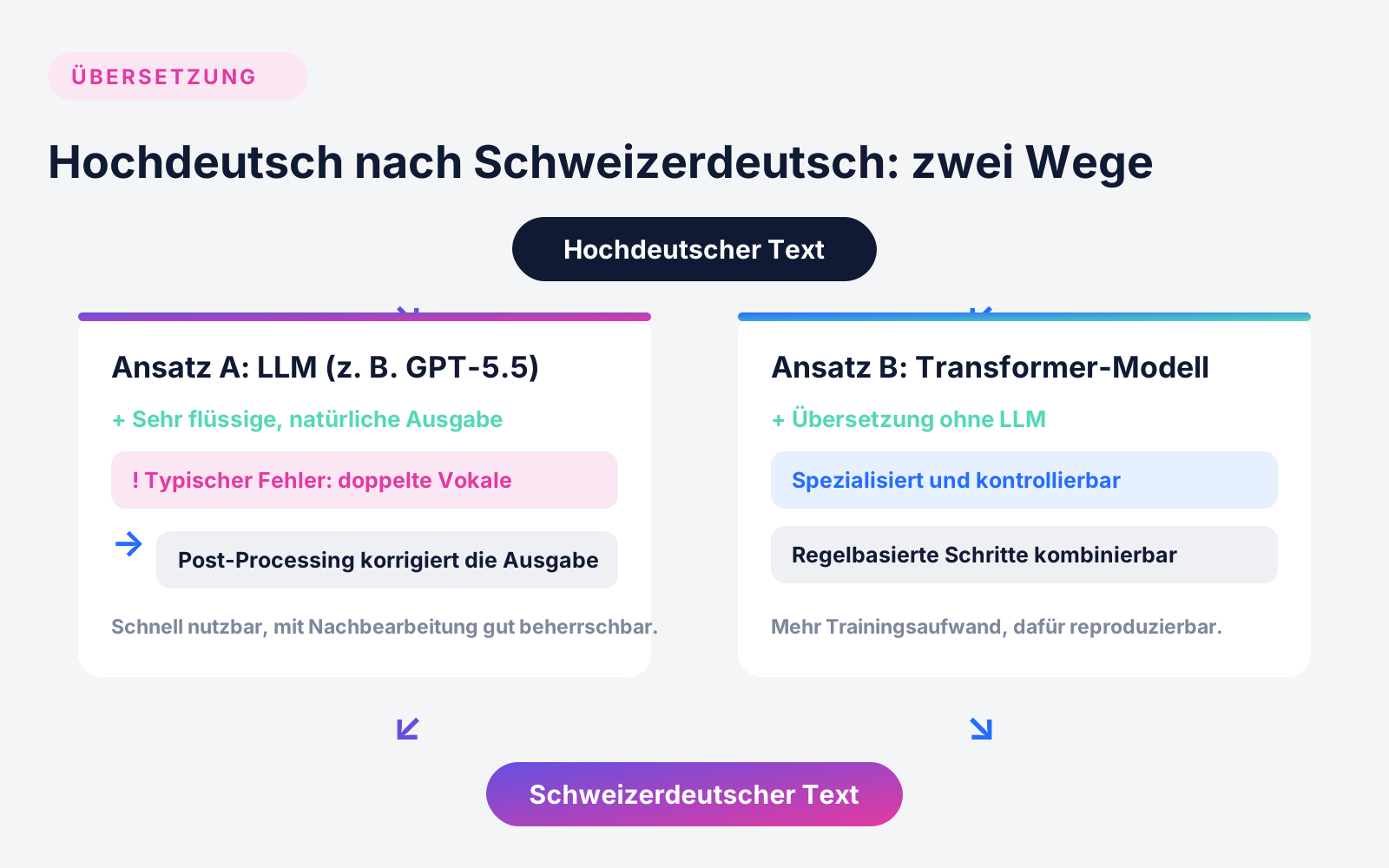
Large language models such as GPT-5.5 are surprisingly good at rephrasing Standard German into Swiss German. They produce fluent, natural sounding dialect, usually strike the right tone, and confidently handle many lexical substitutions that once required hand-maintained rules. For a large share of everyday sentences, the result is usable straight away.
Even so, two typical weaknesses recur. First, the models sometimes stay too close to Standard German and deliver a phrasing that is superficially tinted with dialect but written German at its core. Second, and this is the more interesting case, they overstate the spoken vowel length and double vowels where no established spelling exists. Both patterns are not random but systematic, and that is good news.
The systematic error: doubled vowels
In spoken Swiss German many vowels are lengthened. A language model that has learned from vast, inconsistent bodies of text tries to capture this length in writing and simply doubles the vowel. At first glance the result looks authentic, but it deviates from what practised writers actually use and quickly comes across as overdone.
- The vowel is doubled even though the common spelling uses only a single vowel.
- The lengthening is applied inconsistently: the same word appears once with and once without doubling within the same text.
- Regional patterns get mixed, so a Zurich base form is combined with Bernese vowel lengthenings.
- The doubling also occurs where it reduces readability without capturing the sound more precisely.
Because this error follows a clear logic, it can be described, measured and fixed on purpose. It is therefore not a fundamental obstacle but a concrete, nameable piece of work.
Post-processing as the pragmatic fix
The fastest route to controllable results is a post-processing layer behind the language model. Because the typical errors are systematic, they can be caught with normalization rules: rules correct the spelling, reduce doubled vowels to the common form, and smooth region-typical patterns into one consistent target variant.
This approach combines the linguistic strength of the model with the reliability of deterministic rules. The model handles the creative rephrasing, the rule layer ensures consistency and reproducibility. For many applications, such as preparing text for speech output, exactly this mix of fluency and control is decisive.
A dedicated transformer model as the alternative
Instead of sharpening a general language model with rules, you can train a dedicated transformer model specifically for the direction Standard German to Swiss German. Such a specialized model is more controllable and more reproducible, because it targets this single task and its behaviour can be steered more tightly.
The price for that is effort. A dedicated model needs more training data and more development work than a prompt to an existing language model. For Swiss German in particular, where clean training data is scarce, this is a serious hurdle. In practice a hybrid setup is therefore often sensible: a model for the rephrasing, a rule layer for the fine correction.
Control versus coverage: choosing the approach
There is no single correct approach. The decision depends on how much the need for control and reproducibility weighs against speed and coverage. For orientation:
- General language model with post-processing: quick to deploy, broad coverage, good linguistic quality, controllable via rules.
- Dedicated transformer model: highest control and reproducibility, at the cost of more data and longer development time.
- Hybrid of both: model for the rephrasing, rules for the fine correction, a practical compromise between fluency and reliability.
If you need usable dialect quickly today, the first route serves well. If you need repeatable, verifiable output for a product, plan for a specialized or hybrid system.
The data situation for Swiss German
Training and evaluation data for Swiss German is comparatively scarce. Because the language is spoken and shaped without a binding spelling, there is less consistently annotated material than for major written languages. This complicates both the training of dedicated models and the robust evaluation of results.
Documented corpora do exist, however, among them collections curated by the SwissNLP association (swissnlp.org), the Swiss association for Natural Language Processing. Such resources are the starting point for any serious project in this field, because without reliable data every assessment of quality stays anecdotal.
Recommendation and conclusion
Our practical recommendation is clear: start with a strong language model for the rephrasing and add a rule layer that corrects doubled vowels, normalizes the spelling and enforces one consistent target variant. This hybrid setup delivers fluent yet controllable results fastest. Where maximum reproducibility is required, the additional step to a dedicated transformer model pays off.
ORO Solutions evaluates both approaches in a research and proof-of-concept project on Swiss German speech output that combines dialect rephrasing with text-to-speech. The goal is a natural sounding, regionally consistent speech output that can be measured and reproduced rather than only happening to sound good.
FAQ
Frequently asked questions
Is there a correct spelling for Swiss German?
No. Swiss German is a spoken language with no binding, officially defined orthography. The same sentence can be written down correctly in several ways, which is why a system always has to pick a spelling convention and usually a region as well.
Can current language models produce Swiss German?
Yes, models such as GPT-5.5 already produce fluent and natural sounding dialect. They do tend toward two systematic errors, though: they sometimes stay too close to Standard German, or they double vowels to capture the spoken length. Both patterns can be corrected on purpose.
What is the doubled-vowel problem?
Language models overstate the spoken vowel length and write vowels twice where no established spelling exists. The error often appears inconsistently and mixes regional patterns. Because it follows a clear logic, it is measurable and fixable with normalization rules.
Rule-based post-processing or a dedicated model?
A language model with post-processing is quick to deploy and covers a broad range. A dedicated transformer model is more controllable and more reproducible, but needs considerably more training data and development effort. In practice, a hybrid of model and rule layer is often the best compromise.
What about training data for Swiss German?
The data situation is comparatively scarce, because the language is spoken and shaped without a fixed spelling. Documented corpora do exist, however, among them ones from the SwissNLP association (swissnlp.org). These resources are the basis for training and for robust evaluation.
Keep reading
Related articles