Speech synthesis
Text-to-speech for Swiss German: training, data and law
Text-to-Speech · 11 July 2026 · 9 min read
A convincing Swiss German voice is technically feasible today. Getting there depends on cleanly prepared data, targeted fine-tuning and a clear legal framework. This article explains how the training works, which data exists, and what to watch for around voice rights and data protection.
What text-to-speech delivers today, and why Swiss German is harder
Text-to-speech (TTS) turns written text into spoken audio. For Standard German and English, modern systems already sound very natural: stress, rhythm and timbre come close to a human recording, and the results work in telephony, e-learning, accessibility and product videos.
Swiss German is considerably harder, for two main reasons. First, training data is rare: large, cleanly annotated collections of spoken Swiss German are barely available for free. Second, there is no unified spelling. The same word is written differently depending on dialect and person, and Zurich German, Bern German and Valais German differ substantially in pronunciation and vocabulary.
This combination of data scarcity and missing standard orthography is why a Swiss German TTS system cannot simply be bought off the shelf, but has to be built deliberately.
How a Swiss German voice is built: fine-tuning instead of training from scratch
In practice, a Swiss German TTS model is almost never trained from scratch. Instead, a pre-trained TTS model is adapted through fine-tuning. The starting point is a specific speaker voice: with enough cleanly prepared recordings, the model learns the sound, rhythm and pronunciation of exactly that voice.
The benefit is twofold. The pre-trained model already carries a general understanding of speech, sounds and prosody, so the target voice needs far less recorded material than training from scratch would. At the same time, the identity of the voice is preserved, because the fine-tuning is aimed at a single speaker profile.
Data preparation: from raw recording to training set
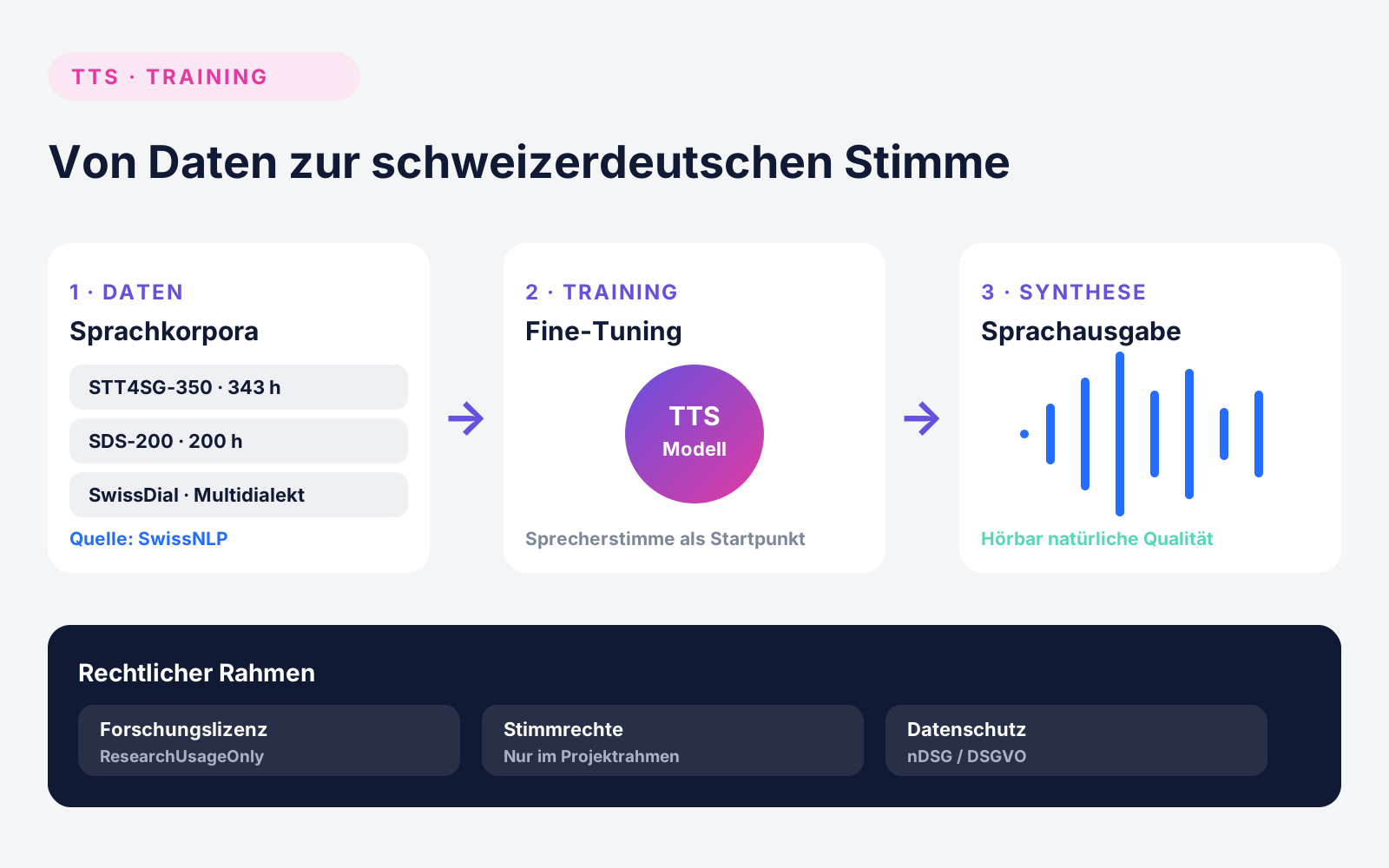
A TTS project runs through three main stages: data preparation, training or fine-tuning, and finally the synthesis of new sentences. The most demanding and quality-defining part is data preparation, because a model only sounds as good as the data it learned from.
- Segmentation: long recordings are split into short, clean audio segments.
- Transcription: the spoken text is captured for each audio segment.
- Alignment: text and audio are matched precisely in time.
- Cleaning: noise, slips of the tongue and unusable passages are removed.
Only this clean, aligned set of audio and text makes stable fine-tuning possible. Errors at this stage, such as mismatched transcripts or noisy recordings, feed straight through into the quality of the synthetic voice.
Where the training data comes from: the SwissNLP corpora
Publicly documented Swiss German speech corpora exist. They are curated by SwissNLP (swissnlp.org), the Swiss association for Natural Language Processing. Three datasets are particularly relevant:
- STT4SG-350: about 343 hours of Swiss German audio, balanced across all dialect regions.
- SDS-200: about 200 hours of Swiss German audio with Standard German reference texts.
- SwissDial: a parallel, multidialectal corpus of spoken Swiss German.
These research corpora provide a solid basis for the dialectal breadth of a model. On top of that, project-specific recordings of a provided speaker voice can be added, so the fine-tuning targets exactly the intended voice.
Research-only licence: what it means in practice
The corpora above are provided under a research-only licence (META-SHARE ResearchUsageOnly, no redistribution). This matters legally: the data may be used for research but not redistributed, and any commercial use has to be licensed separately.
For a production product this means you cannot simply use these datasets as the basis of a voice you sell. Anyone planning commercial use should clarify the licence up front with the rights holders, or rely on their own, cleanly licensed recordings. This question belongs at the start of a project, not at the end.
Voice and personality rights
A voice is not neutral raw material, it is a feature of a person. A cloned voice may only be used within the agreed scope and with the consent of the speaker.
In practice this means the purpose, scope and duration of use should be set out contractually. If a voice is used beyond the agreed scope, for other clients, other topics or advertising, it can infringe the speaker's personality rights. A clear consent and usage framework protects both sides.
Data protection: nDSG and GDPR
Speech recordings are personal data. In Switzerland the revised Data Protection Act (nDSG) applies; where there is an EU connection, the GDPR applies as well. Both require, among other things, a clear legal basis, purpose limitation and transparency towards the people concerned.
Anyone recording, processing and storing Swiss German voices should therefore decide from the outset where the data is held, who has access, how long it is retained and for what purpose it is processed. Data protection here is not an afterthought, it is part of the project architecture.
Practical checklist and conclusion
A convincing Swiss German voice is achievable with today's technology. What matters is clean data and a clear legal framework. Anyone starting a project should settle the following points early:
- Data licence: are the corpora and recordings used licensed for the intended purpose?
- Voice rights: is there written consent from the speaker for the specific scope of use?
- Data protection: are storage location, access, retention period and purpose handled in line with the nDSG (and the GDPR where relevant)?
- Data quality: are the recordings cleanly segmented, transcribed and aligned?
- Dialect coverage: does the data match the intended target region and target voice?
Projects that consider licences, voice rights and data protection from the beginning reach a workable result faster than those that raise these questions only at the end. The technology is mature; the difference lies in the care taken with data and law.
FAQ
Frequently asked questions
Can a Swiss German voice be created without your own recordings?
In principle, recordings of the target voice are needed so the model can learn its sound. Public research corpora provide dialectal breadth but do not replace the specific recordings of the desired speaker voice. Commercial use also requires cleanly licensed or self-collected data.
How many recordings are needed for fine-tuning?
That depends on the pre-trained model and the quality target. Because the base model already brings general language knowledge, far less material is usually needed than training from scratch. Quality matters more than sheer quantity: clean, well-aligned recordings without noise.
May I use the SwissNLP corpora for a commercial product?
Not without further steps. Datasets such as STT4SG-350, SDS-200 and SwissDial are under a research-only licence and may not be redistributed. Commercial use has to be clarified separately with the rights holders.
Which legal questions are central for a cloned voice?
Three areas: the data licence of the training data, the personality rights in the voice (consent and agreed scope of use), and data protection under the nDSG and, where relevant, the GDPR. These points should be settled contractually before the project starts.
Why is Swiss German harder than Standard German?
Because training data is rarer and there is no unified spelling. Dialects differ strongly in pronunciation and vocabulary, and the same sound is written in different ways. That makes data preparation and modelling more demanding.
Keep reading
Related articles