
 Research / POC
Reference case / Applied AI
Swiss German text-to-speech AI
ORO Solutions is building an end-to-end AI workflow that automatically turns Standard German ad copy into regionally fitting Swiss German and voices it as speech in an audibly natural quality. The result is a radio-ready audio spot that sounds, in each region, as if a local voice had recorded it. The initiative is applied AI and NLP research by ORO Solutions, carried out in 2026 as a bachelor thesis at the FHNW, a Swiss university of applied sciences. It focuses on three target dialects: Zurich German, Bern German and Basel German. The application context is regional audio spots for Swiss radio, where advertising is increasingly played out by region. The project combines language processing, speech synthesis and a careful handling of research data into a scalable solution for regional voicing.
At a glance
Project at a glance
Context
The challenge and the goal
Swiss radio plays out audio spots with ever finer regional targeting. A spot that sounds in Zurich, Bern and Basel in the respective local dialect is perceived as closer and more credible than a single Standard German version. That is precisely where effort arises: each region needs its own linguistic adaptation and its own voicing.
Traditionally this means several manual production steps per dialect, from rephrasing the text to a studio recording with a local speaker. It is time-consuming and inflexible as soon as copy needs to change at short notice or many variants have to be produced.
The goal of ORO Solutions is an automated, scalable workflow: Standard German ad copy in, radio-ready audio spot in the desired Swiss dialect out. The solution turns standard language into regionally fitting Swiss German and voices it with a text-to-speech voice in natural sound quality.
Approach
The end-to-end workflow
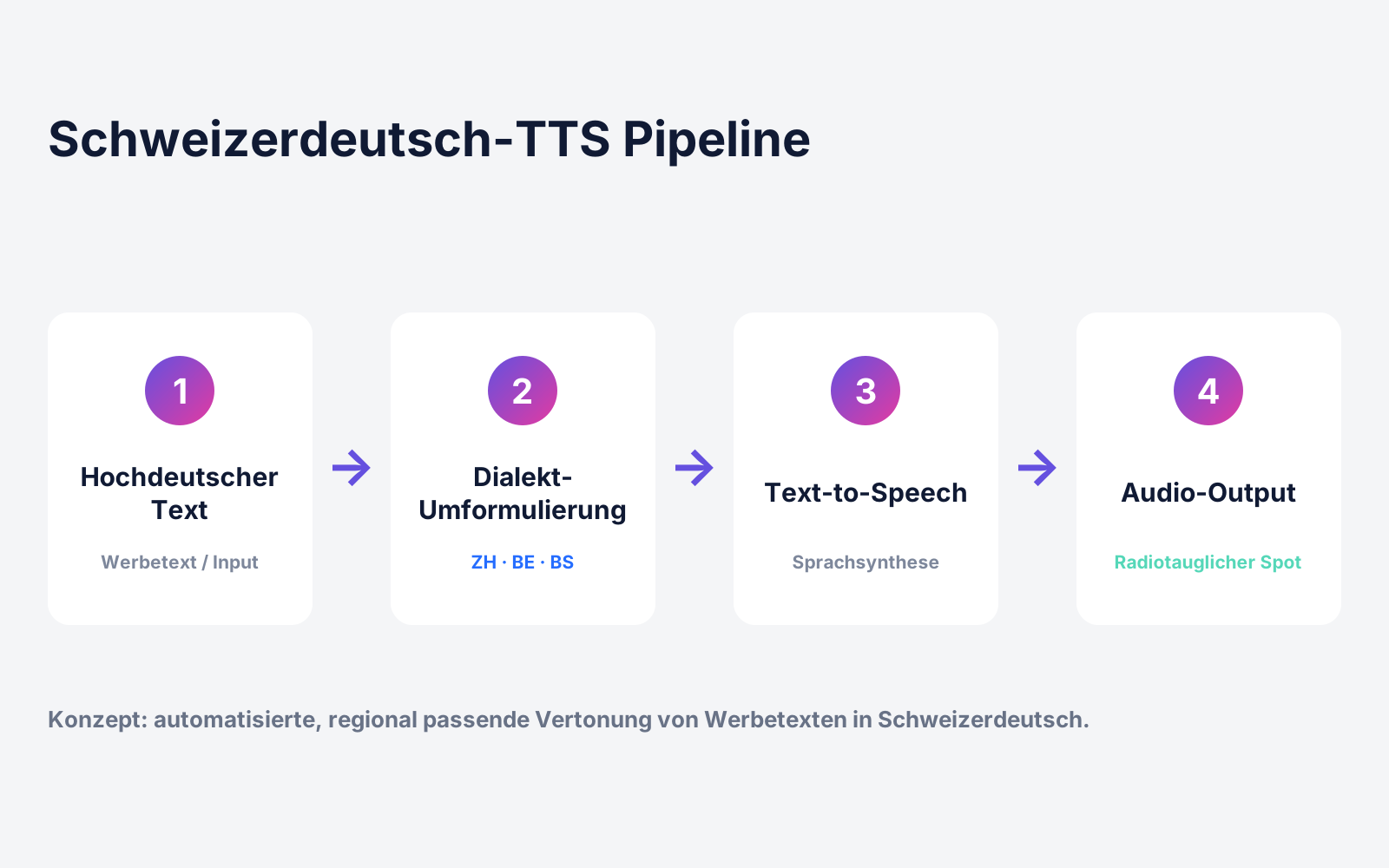
The workflow is built as a continuous pipeline. It takes Standard German ad copy and delivers a finished audio spot in the target dialect. The four stages fit together seamlessly.
- Input: the Standard German ad copy serves as the starting point of the pipeline.
- Rephrasing: the text is automatically transferred into the chosen target dialect (Zurich, Bern or Basel).
- Voicing: a fine-tuned text-to-speech voice speaks the dialect text in natural quality.
- Result: a radio-ready audio spot for the respective region.
For the dialect rephrasing, ORO Solutions compares LLM-based approaches with dedicated model approaches. For the voice, a Swiss German voice is fine-tuned from a speaker voice.
Data foundation
Research data and legal framework
ORO Solutions trains and evaluates on publicly documented Swiss German corpora from the SwissNLP association (swissnlp.org), the Swiss association for Natural Language Processing. This data foundation is well documented and balanced across regions, which is decisive for reliable dialect coverage.
- STT4SG-350: about 343 hours of audio, balanced across all dialect regions of German-speaking Switzerland.
- SDS-200: about 200 hours, with Standard German reference texts as a parallel anchor.
- SwissDial: a parallel, multidialectal corpus for comparing the dialects.
The research corpora are used under a research-only license (ResearchUsageOnly, no redistribution). ORO Solutions adheres to this framework consistently, a mark of professional and legally sound data handling.
Source: SwissNLP, dataset overview (swissnlp.org).
The technology behind the pipeline
The initiative connects two AI disciplines into a chain: dialect rephrasing in the field of natural language processing and speech synthesis in the field of text-to-speech. For the rephrasing, ORO Solutions deliberately contrasts two paths: large language models (LLMs) and dedicated model approaches tailored to the task. This makes it possible to choose the most suitable approach for each target dialect.
For the voice, a Swiss German text-to-speech voice is fine-tuned from a speaker voice. As a result, the output does not sound like neutral standard synthesis but like a natural, regionally rooted voice.
Why it matters for businesses
Regional address works. Speaking to an audience in its familiar dialect creates closeness and attention. An automated workflow makes that closeness economically scalable: from a single Standard German text, several regional versions emerge without setting up a separate studio production for each region.
- Scalability: several dialect variants from a single text source.
- Flexibility: short-notice copy changes flow directly into new spots.
- Regional impact: address in the local dialect instead of a single standard version.
The competence of ORO Solutions
This reference case shows how ORO Solutions brings together AI, NLP and speech technology into an application-oriented solution. As a research and proof-of-concept project within a bachelor thesis at the FHNW, the initiative combines academic rigor with a concrete, market-relevant use case. This combination of methodology, sound data handling and a clear link to value is characteristic of how ORO Solutions works in applied AI.
Relevance
Value and outlook
Regional voicing is a genuine advantage in the Swiss radio market, and producing it has so far been laborious. The ORO Solutions workflow makes it automatable and scalable: standard language in, a regional Swiss audio spot out.
As an applied research project on Swiss German, language processing and speech synthesis, the case underlines the competence of ORO Solutions in AI and speech technology and shows how these capabilities translate into a concrete, valuable use case.
Insights
The workflow in pictures
Read on